Stop CNP Fraud. Optimize Authentication.
Real-time fraud intelligence that reduces friction and turns 3DS into a competitive advantage

Trusted by leading financial institutions around the world



Smarter, more accurate fraud detection and authentication for 3-D Secure
Increase approvals and reduce fraud with more accurate risk decisioning for every transaction.
>95%
transaction success rates
>98.5%
fraud detection rates
$12B+
annual fraud savings across customers
Modernize your 3-D Secure for today’s threat landscape
Confirm both the user and the transaction with modern authentication and risk-aware decisioning to reduce CNP fraud and detect scam-related manipulation during authentication.
Outseer 3-D Secure is an EMV® 3-D Secure Access Control Server (ACS). It combines consortium intelligence from the Outseer Global Data Network with advanced analytics to assess transaction risk.
Authentication is applied proportionately based on risk level, regulatory and scheme requirements, and issuer risk appetite.
Native behavioral biometrics strengthen vulnerable points in the journey, such as OTP. They verify how users interact in real time, helping detect social engineering and impersonation.
FIDO passkeys deliver phishing-resistant authentication, while Outseer assesses the risk of each transaction. Together they provide bank-grade protection against phishing, account compromise, and CNP fraud.

Why isn’t transaction data enough to detect fraud?
Fraud is complex. Transaction data alone can’t reveal the full picture.
Outseer combines consortium intelligence from the Global Data Network with cross-channel signals, in-depth device signals, and behavioral biometrics. This broader view identifies emerging threats earlier and detects fraud more accurately.
The result is stronger protection, fewer false positives, and more confident decisions.

What’s the cost of false positives?
False positives create unnecessary work. Every alert drives investigations and customer contact, increasing operational costs.
Outseer improves decision accuracy using real-world fraud signals and advanced analytics. This reduces false positives, helping teams focus on genuine threats and operate more efficiently.
The result is lower operational costs and a better customer experience.

How do increased approvals drive interchange revenue?
Transactions are often declined unnecessarily, leading to lost revenue and customer abandonment.
Outseer improves decision accuracy to better identify genuine transactions and reduce unnecessary declines. This increases approvals while maintaining strong fraud protection.
The result is higher interchange revenue and stronger cardholder loyalty.

How do you keep up with evolving 3-D Secure and regulatory requirements?
As an active EMVCo board member, Outseer maintains close alignment with the card networks and evolving 3-D Secure standards. This helps issuers adapt to changing global and regional requirements.
Issuers are supported in meeting regulatory and scheme requirements, including PSD2 and Strong Customer Authentication (SCA) mandates.
The result is faster compliance and the flexibility to adapt to global and regional mandates.
Drive control and efficiency

Make smarter decisions with flexible, risk-driven control
Apply configurable rules to real-time risk signals from the Outseer Risk Engine and 3-D Secure protocol data to accurately approve, challenge, or decline transactions.
Define and adapt policies to reflect your risk appetite, regulatory requirements, and business objectives. Gain fine-grained control over transaction and protocol data to determine how and when authentication is applied—balancing fraud prevention with customer experience.

Investigate faster. Resolve with confidence.
Track, investigate, and resolve suspected fraud linked to Policy Manager decisions. Each case includes rich transaction context, helping analysts quickly assess risk and take action.
Outcomes feed directly back into policies and the Risk Engine, creating a continuous feedback loop that improves decision accuracy over time.

Control challenge experiences without complexity
Design and manage 3-D Secure challenge flows without reliance on professional services. Quickly deploy changes to how and when challenges are applied.
Tailor journeys to reflect your brand, language, and customer context, with messaging and workflows driven by risk signals and policies. Adapt experiences across transaction types to reduce friction and improve completion rates.
Reusable templates make it easy to scale, while maintaining flexibility. The result is faster updates, lower costs, and greater control over the customer experience.
Superior data science and technology
Advanced data, AI-driven decisioning, and modern authentication technologies work together to deliver accurate fraud detection and low-friction customer experiences.
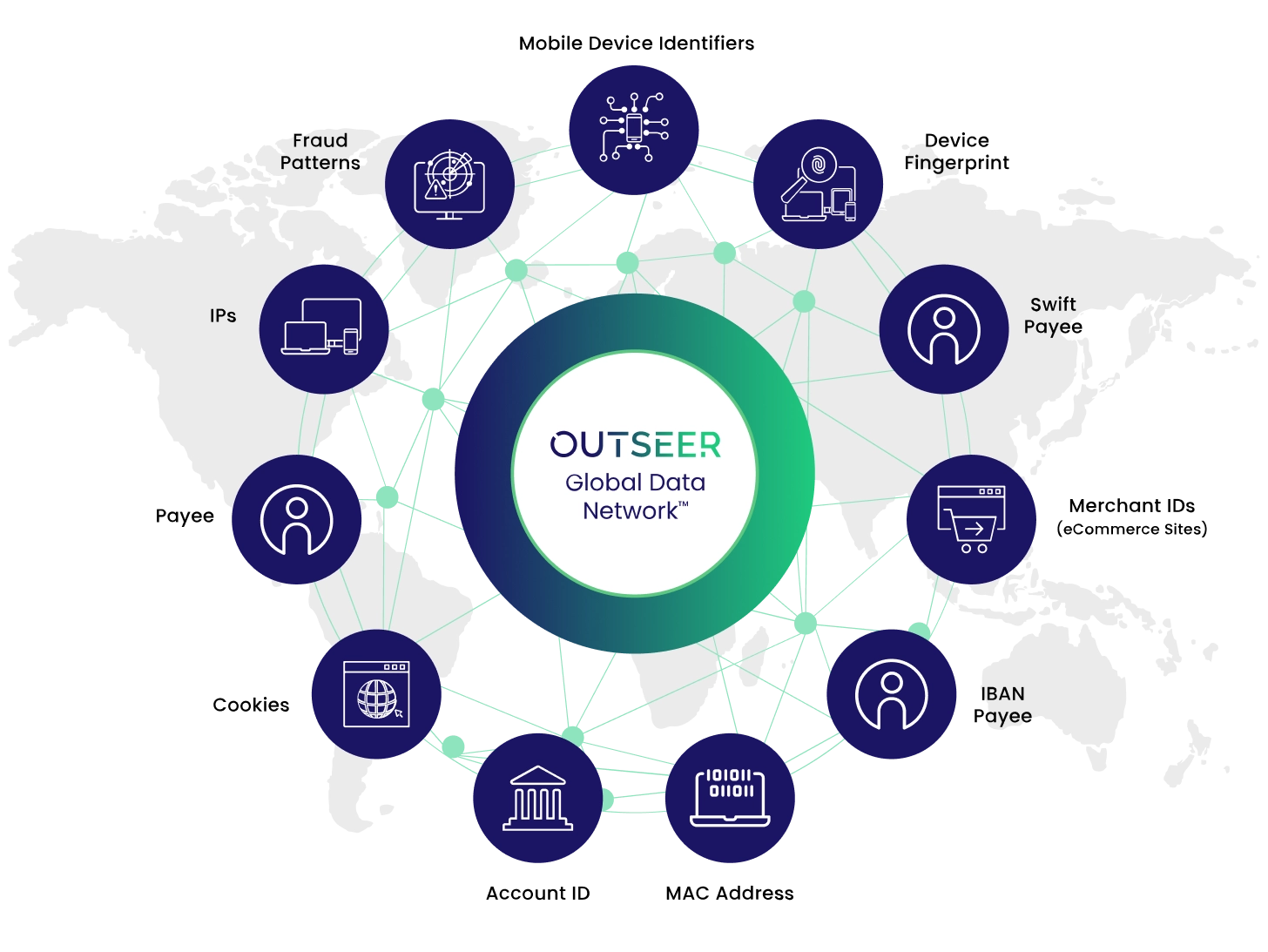
Global Data Network
Consortium intelligence for more accurate fraud detection
Aggregates confirmed fraud signals from across the Outseer network, providing early visibility into emerging threats to improve detection accuracy.

Outseer Risk Engine
Real-time risk assessment for precise decisioning
Evaluates transaction, behavioral, and device signals to determine risk and apply authentication proportionately.
Fully featured platform for layered fraud prevention

Suite of modern authenticators
Support a range of modern authentication methods, including FIDO-based passkeys, to confirm user identity. Each interaction is assessed using device, behavioral, and transaction signals to ensure the right level of assurance.
Low-risk activity flows with minimal friction, while higher-risk activity is stepped up or blocked in line with regulatory requirements including PSD2/PSD3, scheme requirements, and issuer risk appetite.

Native behavioral biometrics
Analyze how users enter an OTP during the 3-D Secure challenge to detect scams, social engineering, and account compromise in real time. This provides an additional layer of assurance at a critical point in the authentication journey.
By identifying deviations from normal behavior, it helps determine whether the OTP can be trusted, strengthening protection against increasingly sophisticated fraud.

3-D Secure APIs
Integrate 3-D Secure into your existing systems with real-time access to protocol data, risk signals, and transaction outcomes.
APIs enable issuers to influence decisions in real time, control challenge experiences, and connect out-of-band authenticators, including issuer apps and third-party methods.
All data can be fed into internal systems and data lakes to support reporting, analytics, and downstream authorization decisions.

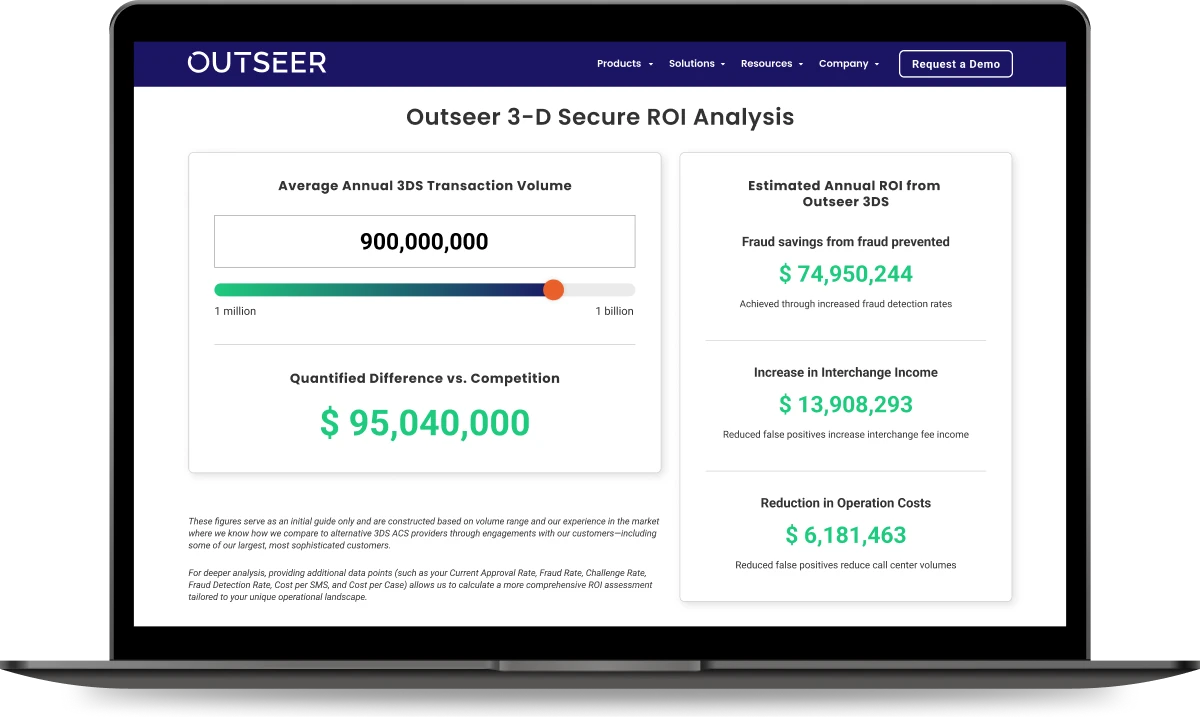
See how much you could increase profits with our ROI calculator
Estimate the financial impact for your institution
Use our simple calculator to input key transaction data and estimate the savings you could achieve with Outseer compared to industry benchmarks. For a more tailored view of your ROI, speak to our experts for a detailed assessment.



Frequently asked questions about 3-D Secure risk and fraud prevention
What is a 3-D Secure risk engine?
A 3-D Secure risk engine evaluates the risk of an online card transaction in real time. It uses data such as device information, user behavior, and transaction context to determine whether authentication is required.
Advanced risk engines use AI and consortium data to reduce fraud while minimizing customer friction.
How does FIDO authentication work with Outseer 3-D Secure?
FIDO-based authentication, such as passkeys, confirms that the person initiating a transaction is the legitimate user through secure, phishing-resistant credentials. However, on its own, FIDO answers only one question: is this the user? It does not assess whether the transaction itself is high risk.
Outseer combines FIDO authentication with real-time risk intelligence. It evaluates device, behavior, and transaction context during authentication to determine whether the activity is safe.
This transforms FIDO from a login mechanism into a bank-grade control within the 3-D Secure journey.
What data does a 3-D Secure risk engine use?
A modern 3-D Secure risk engine combines multiple data sources, including:
• Transaction data
• Device and browser intelligence
• User behavior and session patterns
• Behavioral biometrics
• Geolocation data
• Consortium fraud intelligence
This multi-layered approach improves detection accuracy and reduces false positives.
How do behavioral biometrics help prevent fraud in 3-D Secure?
Behavioral biometrics analyze how a user interacts with the authentication page, such as typing speed, swipe patterns, and navigation behavior.
This helps detect deviations from normal behavior that may indicate social engineering, account compromise, or authenticated fraud.
What is consortium data and why is it important for fraud detection?
Consortium data is shared intelligence from multiple financial institutions based on confirmed fraud events.
It helps identify emerging threats earlier and improves detection accuracy by providing a broader view of fraud patterns across the ecosystem.
Why is native behavioral biometrics better than a point solution?
Native behavioral biometrics are embedded directly within the 3-D Secure authentication flow, making them easier to deploy and more cost-effective than standalone solutions.
They also enable faster decisioning and tighter integration with other fraud signals, improving both detection accuracy and customer experience.
How does AI improve 3-D Secure Authentication?
AI models trained on large volumes of transaction data can identify subtle fraud patterns that rules-based systems often miss.
This enables more accurate risk scoring, higher approval rates, and better fraud prevention outcomes.
How can issuers reduce fraud without increasing customer friction?
Issuers can reduce fraud while maintaining a seamless customer experience by using:
• AI-driven risk scoring
• Behavioral biometrics
• Consortium data
• Risk-based decisioning
These capabilities ensure that only high-risk transactions are challenged, while low-risk activity flows with minimal friction.
What is step-up authentication in 3-D Secure?
Step-up authentication occurs when a transaction is deemed high risk and requires additional verification, such as a one-time passcode or biometric check.
Effective risk engines minimize step-ups for low-risk transactions while applying stronger authentication only when needed.
How does Outseer improve approval rates in 3-D Secure?
Outseer improves approval rates by using highly accurate risk scoring, enriched data signals, and intelligent orchestration to identify legitimate transactions with confidence.
This reduces unnecessary declines and authentication challenges, increasing approvals while maintaining strong fraud protection.
What is risk-based authentication in 3-D Secure?
Risk-based authentication uses real-time risk assessment to determine when and how authentication should be applied.
Low-risk transactions can be approved with minimal friction, while higher-risk activity triggers step-up authentication. This balances fraud prevention with customer experience.
Experience 3-D Secure for yourself
Reduce fraud, prevent scams, and protect customers with industry-leading accuracy and minimal customer intervention.