New Zealand Government Established Anti-Scam Alliance

On July 10, 2025, The New Zealand government announced the creation of the New Zealand Anti-scam Alliance. This comes on the heels of the New Zealand Bankers Association announcement in April 2025 “updating the Code of Banking Practice for the countries banks to better protect customers from scammers.” According to the government press release, Commerce and Consumer Affairs Minister Scott Simpson says:
“Up until this point New Zealand’s anti-scam efforts have developed in an ad-hoc way and suffered from a lack of coordination. We frequently hear that real-time information on scams is sourced from different areas across government and the private sector, making for a fragmented, and often, slow response.
“The Alliance addresses this by establishing a formal structure for government agencies, banks, telecommunications companies, digital platforms sectors, and consumer groups to share data about scams and shut them down in real-time.”
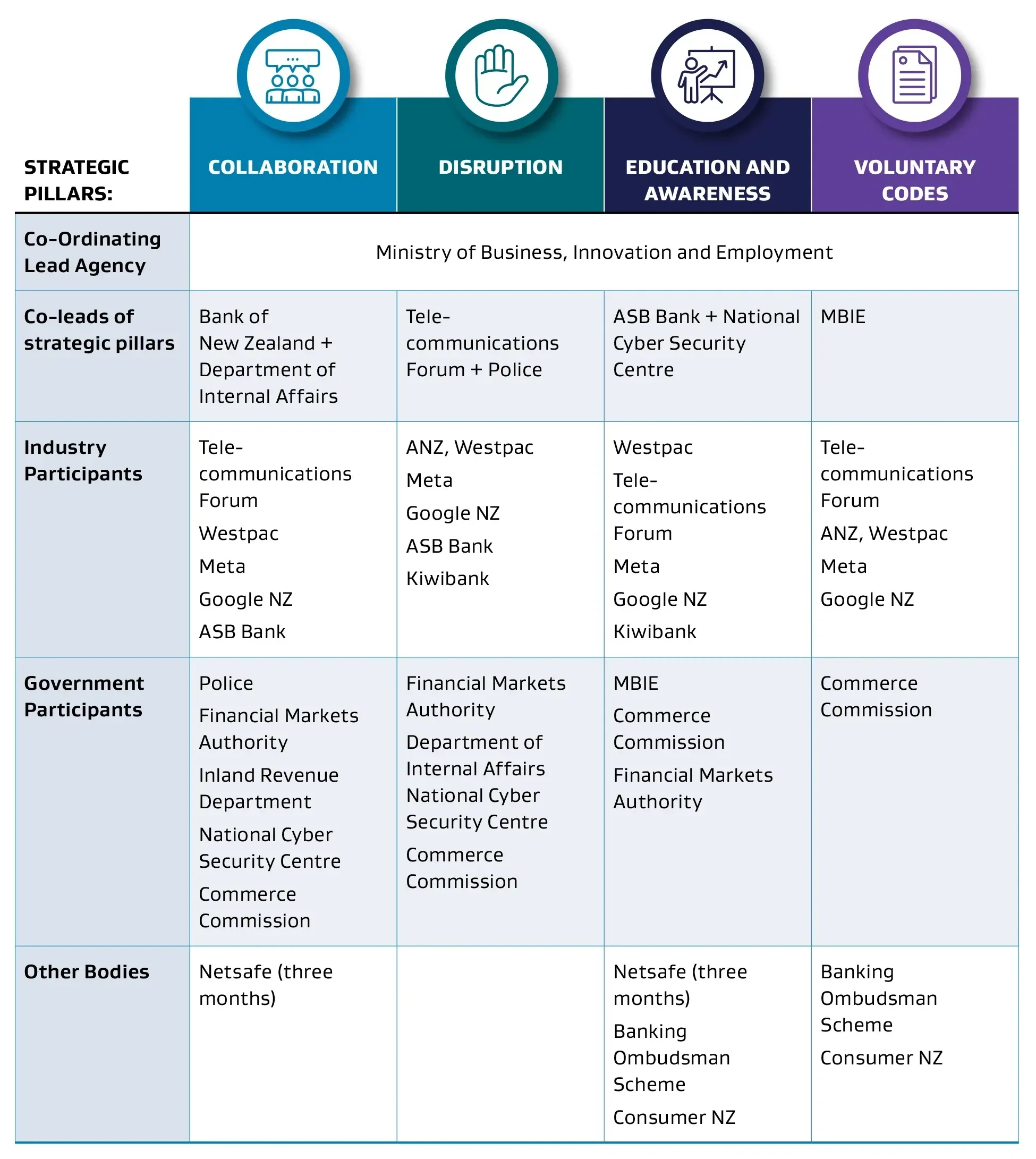
The Alliance issued its first report. Within the report, the Alliance listed four key objectives:
- Collaboration
- Disruption
- Education and Awareness
- Voluntary Codes
With collaboration, the plan is to increase data sharing between the public and private sector. Following the Australian Financial Crimes Exchange (AFCX) model would be a good start. Maybe they could share part of the AFCX structure. Plus, this objective focuses on better coordination between the members.
With disruption, the Alliance wants to “tackle scammers at scale by uniting national efforts across and between Government, law enforcement, not-for-profit organizations, regulators and the private sector.” The Alliance also wants to engage with key international organizations.
With education and awareness, the Alliance wants to help businesses educate consumers. And also provide direct education to consumers.
With voluntary codes, the government wants the industry bodies to establish “voluntary sector codes which set standards for the prevention, detection of and response to scams.”
The report showed a list of current members and where they will participate.
The Alliance will finalize its work plan by December 2025.
So, how well will this Alliance work? It will take a ‘strong hand’ by the New Zealand government to make this Alliance effective. Singapore and the UK governments come to minds as best examples of governments, with a ‘strong and firm hand’, driving the scam loss curve down (yes, Singapore scam losses rose in 2024, but it was a small number of large losses that caused the increase in scam losses). These governments, including their regulators, have effectively required banks to add critical controls to help reduce consumer scams. The UK also has the Online Safety Act legislation for digital platforms and Singapore added telco controls, along with bank controls, to reduce phishing losses. Can the New Zealand government match that action?
New Zealand has chosen a non-legislative approach to solve the consumer scam problem. The banks, telcos and digital platforms need to add controls to prevent 1) scams from starting and 2) stop the money leaving the financial institution. To stop the scams from starting requires digital platforms to quickly remove any bogus ads and websites. The digital platforms need to better vet their customers. Dating sites need a real KYC effort to remove scammers.
To stop the money leaving the financial institution, the New Zealand banks need more than their current five voluntary scam controls. As an example, the banks need to commit to strong money mule management and have strong controls around account opening. All of these controls do not need to be part of the banks’ existing voluntary scam reimbursement program. Put in strong controls to reduce consumer scams independent of reimbursement.
Effective data sharing amongst the participants in imperative. Singapore is one to follow with its COSMIC data sharing program. Maybe the GASA Global Signal Exchange can help in New Zealand. And of course, the Australian AFCX program should be looked at.
From a consumer side in New Zealand, there is already concern about the short list of voluntary bank controls to help reduce consumer scams. I asked Janine Starkes, consumer advocate and writer for two New Zealand newspapers, what she thought of the new Alliance. She said: “New Zealand is infamous in the local market for the protection of Aussie banks, allowing them to write their own rules and avoid liability in key areas (such as receiving bank scam liability). The scam alliance is an extension of this.” She also added: “This alliance stands in stark contrast to our Australian neighbors who have mandates and fines – the same banks operate in both markets.”
This Alliance needs to show it is serious about reducing scams. That means causing some pain for banks, telcos and digital platforms in order to get really meaningful controls.
The New Zealand Post said: “The Government has unveiled a public-private ‘alliance’ to fight scams, and among its aims is to get Apple, Discord, Google, Meta, Snap, TikTok, Twitch, X and Yahoo to sign up to a voluntary anti-scam code.” The government has to prove it can get these digital platforms on board.
Final Thoughts
I want the New Zealand model to be a winning model. It has the potential to be one of the best. Part of my measure of the Alliance’s success will be consumer groups saying scam losses are dropping and the banks, telecoms digital platforms are making a difference in this fight. We are up against transnational organized crime and we have to fight back tough. I thought Singapore hit hard with its recent “if we think the customer is in a scam, just block their account.” That is a hammer, but the customer still has his money. Some customers won’t like that. There will also be things banks, telcos and digital platforms won’t like, if the New Zealand government manages the Alliance correctly. And that is ok. We need to save our consumers from losing their life savings. We need to play hard ball! Maybe New Zealanders would say “Kia Kaha.” Go Kiwis!!