
3-D Secure is a foundational layer of card-not-present payment security. The protocol has helped issuers and payment processors create a structured way to authenticate digital transactions, support risk-based decisions, comply with regulations, and reduce fraud exposure without forcing every transaction through a high-friction path. But 3DS compliance is no longer enough.
Why it matters: 3DS creates a common framework for how merchants, schemes and issuers exchange authentication information. It does not standardize the intelligence applied to each decision, or the resulting levels of fraud, friction, operational effort and transaction success.
The protocol is standardized. The outcomes are not.
What has changed: Card-not-present fraud now extends beyond stolen credentials and conventional attacks. Issuers must contend with scams, social engineering, compromised OTPs, bots, emulated devices and transactions that are successfully authenticated but still fraudulent. In this environment, completing an authentication challenge does not necessarily establish transaction trust.
What issuers need: A modern ACS must interpret behavioral, device, transaction, and contextual fraud signals to make risk decisions in real time. It must also determine when a transaction should proceed frictionlessly, require stronger authentication, or be treated as high risk. Performance should be measured across fraud reduction, customer experience, operational efficiency, and commercial outcomes, not protocol compliance alone.
The next performance frontier for 3DS is improving decisions in real time with the right signals, policies, fraud intelligence, authentication options, analytics, and operational workflows.
Where Outseer fits: Outseer combines authentication modernization with deep fraud intelligence. It turns 3DS intelligence into better issuer outcomes, helping issuers stop more fraud, challenge less often, and improve performance over time. It does this by combining behavioral, contextual, and consortium signals with real-time decisioning, modern authentication, analytics, and expert Fraud Advisory to tune and refine outcomes.
The result is a more adaptive approach to 3DS: more relevant signal, less unnecessary intervention and greater confidence in every transaction decision.
3DS Has Matured But Issuer Expectations Have Changed
The early promise of 3-D Secure was straightforward: add an issuer-controlled authentication layer to card-not-present transactions and reduce fraud risk. In practice, traditional 3DS approaches created a negative perception across the industry because stronger fraud controls introduced added friction for legitimate customers.
For issuers, the challenge has never been fraud prevention alone. It is balancing fraud control with approval rates, abandonment, customer satisfaction, and operational complexity.
Today, richer data and advanced risk-based authentication make it possible to reduce unnecessary friction while preserving the core value of 3DS: issuer-controlled, risk-backed authentication. This has improved the customer experience and enabled more transactions to proceed without a challenge when risk appears low.
Today’s leading issuers are not asking only, “Does our ACS support the protocol?” They are asking harder questions:
- Are we challenging the right transactions?
- Are we letting too much fraud through?
- Are we declining or disrupting good customers?
- Are our fraud teams getting the visibility they need?
- Are our policies flexible enough for changing attack patterns?
- Are we protecting transaction revenue as well as reducing fraud?
- Are authentication outcomes aligned with digital experience goals?
- Can our ACS adapt as fraud shifts from credential theft to scams, manipulation, bots, emulators, and authenticated fraud?
- Can we change policies and configurations quickly as attack patterns evolve?
- Is the platform resilient enough to maintain uptime and withstand availability threats, including DDoS attacks?
- Is our 3DS strategy ready to support emerging commerce models, including agentic commerce?
The answer depends less on protocol support alone and more on the intelligence behind the ACS. A basic, protocol-compliant ACS can participate in the flow. An advanced ACS helps issuers make better decisions and improve outcomes.
The Protocol Is Standardized. The Outcomes Are Not.
3DS is built around structured interactions among merchants, directory servers, issuers, ACS providers, and cardholders. Those standards are critical. They create interoperability, scheme alignment, and a common framework for digital payment authentication.
But standardization can create a misconception: that all ACS providers deliver roughly the same business value.
They do not.
Issuer outcomes can vary dramatically depending on the ACS provider’s risk intelligence, orchestration capabilities, operating model, and ability to learn from fraud patterns over time.
The difference is not simply whether the ACS can process an authentication request. The difference is how quickly it can interpret that knowledge, and how effectively it can turn signals into action.
A high-performing ACS must answer questions in milliseconds:
- Does this transaction fit the cardholder’s normal behavior?
- Does the device, session, merchant, amount, or context look unusual?
- Are there behavioral cues that suggest automation, manipulation, or compromise?
- Has similar activity been observed across broader fraud intelligence sources?
- Should this transaction be approved frictionlessly, challenged, declined, or routed through a specific authentication method?
- What will the decision mean for fraud losses, customer experience, operational review, and transaction revenue?
The protocol provides the structure. The ACS intelligence determines the quality of the decision.
That distinction matters because authentication is not the same as trust. A transaction can pass an authentication step and still be risky. A cardholder can complete an OTP challenge while being socially engineered. A compromised device can appear familiar. A fraudster can use automation to mimic normal flows.
Modern issuers need more than authentication execution. They need transaction trust.
Fraud Has Moved Beyond Basic Transaction Risk
The fraud landscape that shaped early 3DS adoption is not the same fraud landscape issuers face today.
Card-not-present fraud still includes stolen card testing, account takeover, credential compromise, and high-volume automated attacks. But fraud has expanded into more complex patterns that can bypass simplistic authentication assumptions.
Modern fraud teams must contend with:


In this environment, a binary view of authentication is insufficient.
Issuers need to know not only whether a cardholder can complete a challenge, but whether the total context supports the risk decision. That requires a layered understanding of behavior, device, merchant, transaction, network intelligence, authentication method, and issuer policy.
It also requires humility about what any one control can solve. No single authentication method or signal provides a complete trust strategy. Devices can be shared, compromised, or emulated, while transaction data alone may miss broader fraud context.
Fraud has become more adaptive. ACS intelligence must become more adaptive as well.
Turning 3DS Into a Measurable Business Driver
For too long, 3DS has been viewed primarily through a compliance lens. That framing is too narrow.
A well-run 3DS program can influence multiple dimensions of issuer performance. Poorly tuned authentication can harm all of these:
- Fraud losses
- False positives
- Challenge rates
- Approval and success rates
- Customer-service burden
- Manual review workload
- Transaction revenue
- Digital experience
- Portfolio trust
- Executive confidence in fraud strategy
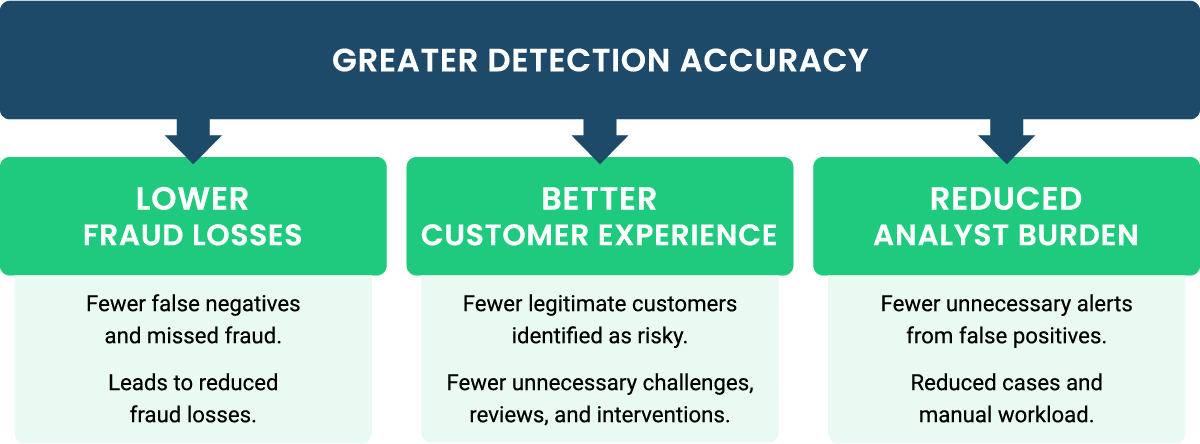
If an issuer challenges too aggressively, good customers may abandon transactions or develop frustration with the card experience. If the issuer challenges too lightly, fraud losses can rise. If policies are too rigid, fraud teams may struggle to respond to new attack patterns. If analytics are limited, leaders may not know whether performance issues are caused by merchant profile, fraud pressure, authentication design, model tuning, or operational process gaps.
Advanced ACS decisioning helps issuers manage these trade-offs more intelligently. The objective is not “maximum authentication.” It is optimal trust.
That means identifying the transactions that can safely move through with minimal friction, applying step-up authentication when it adds meaningful assurance, and recognizing when authentication success alone should not be treated as enough.
When issuers improve decision quality, the benefits can extend across the business:
- Fraud leaders gain more precise controls and better visibility into risk drivers.
- Cards and payments leaders can better protect transaction revenue and optimize the customer journey.
- Digital leaders can reduce avoidable friction in mobile, browser, and in-app experiences.
- Product and technology leaders can align authentication strategy with modern architecture, security, and UX goals.
- Executives can evaluate 3DS as a measurable performance lever rather than a back-office compliance requirement.
This is the shift: from 3DS as a cost of doing business to 3DS as a source of business value.

What Advanced Issuers Should Demand From Their ACS
As issuers modernize their 3DS programs, the ACS evaluation criteria should evolve.
1. Decision Quality That Drives Business Value
Issuers should evaluate the quality of its risk decisions. Can it distinguish trusted customers from suspicious activity? Can it reduce unnecessary challenges without increasing fraud exposure? Can it interpret behavior, device, transaction, and network signals in context? Can it adapt as fraud changes?
2. Native and Contextual Signals for More Confident Decisions
Richer data only matters if the ACS can use it effectively. Advanced issuers should expect an ACS to incorporate relevant native, behavioral, device, transaction, and contextual signals into real-time risk decisions.
The goal is not to collect more data for its own sake. The goal is to create more confidence with less friction.
3. Cross-Channel Fraud Intelligence for Greater Accuracy
Fraud often crosses channels before it appears in a payment transaction. A digital banking compromise, suspicious device pattern, or known fraud behavior may be relevant to a 3DS decision.
Issuers should look for an ACS with intelligence to help connect patterns beyond a single transaction or a single institution’s limited view. Broader network intelligence can help issuers recognize fraud patterns that may not be visible within their own data alone.
4. Flexible Orchestration for the Right Action at the Right Time
A modern ACS should support more than one blunt policy path. Issuers need flexibility to define when to approve, challenge, deny, route, or apply different authentication methods based on risk and business context.
Fraud strategy should not be trapped inside rigid workflows.
5. Modern Authenticators for Evolving Fraud and Better UX
Issuers should expect support for modern authentication methods that improve both assurance and user experience. FIDO strengthens phishing-resistant authentication and improves the user experience, particularly as issuers look beyond legacy challenge methods.
But modern authentication should be integrated into a broader risk strategy. The question is not only whether a provider can support a particular form of authentication. It is when, why, and how that authentication should be applied.
6. Operational Visibility and Workflows
An ACS should help fraud and operations teams understand what is happening. That includes visibility into risk decisions, case activity, policy performance, challenge outcomes, and emerging patterns.
Without operational visibility, issuers are left managing 3DS reactively.
7. Stability and Scale
Large issuers require dependable infrastructure. ACS performance affects checkout, customer experience, fraud prevention, and issuer trust. Reliability, system stability, operational fit, and the total value equation should all be part of provider evaluation.
A 3DS provider is not merely a technology vendor, it is part of the payments trust infrastructure.
8. Advisory Expertise
Fraud strategy cannot be reduced to software configuration alone. Issuers benefit from expertise that helps interpret trends, tune policies, assess performance, and align fraud controls with business objectives.
Experienced fraud advisors can help issuers connect technology decisions to fraud realities and measurable performance goals.
Continue reading part 2 of "From Compliance to Performance: Redefining 3DS for Issuers" and learn How Outseer Supports Smarter 3DS Outcomes.